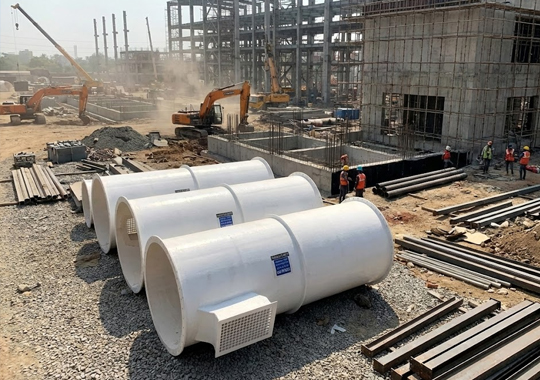
FRP ducting systems are made from fiberglass-reinforced plastic pipes, fittings, and accessories used to carry corrosive fumes, gases, and air streams. The combination of fiberglass and resin provides good mechanical strength while keeping the ductwork lightweight.
FRP ducts are resistant to corrosion and chemical exposure, making them suitable for environments where conventional metal ducting may deteriorate.
These ducting systems can be manufactured in round, rectangular, or customized shapes according to the layout and ventilation requirements of a facility. They are commonly used in factories, chemical processing plants, water treatment facilities, and other industrial locations where fumes or chemically active gases need to be safely transported.
Their resistance to moisture, chemicals, chlorine, and salt-laden air also allows them to be installed in demanding environments, including certain underground applications, when properly designed and supported.
Shourya Composite Industry Pvt Ltd. is a trusted name among FRP ducting manufacturers, offering durable ducting solutions for industrial ventilation and fume-handling needs. Our FRP ducting systems are designed to carry air, fumes, and gases safely in areas where moisture, chemicals, or corrosive conditions are present.
We manufacture PP FRP ducting using suitable materials and careful fabrication methods to meet different industrial requirements. These ducts are available in various sizes, shapes, and configurations, allowing them to fit different plant layouts and ventilation systems.
Their lightweight construction also makes handling and installation more convenient. As an experienced PP FRP Ducting Manufacturer, Supplier, and Dealer, we focus on providing products that match the practical needs of each application.
Our ducting solutions can be used in chemical plants, pharmaceutical units, water treatment facilities, manufacturing industries, laboratories, and other locations requiring reliable fume movement.
Shourya Composite Industry Pvt Ltd. works closely with customers to understand their requirements and provide suitable FRP ducting products. We aim to maintain consistent quality, proper finishing, and dependable service for industrial projects across different locations.
Our Expertise as FRP Ducting Systems Manufacturers
Our expertise as FRP ducting systems manufacturers comes from understanding the needs of industries that work with fumes, gases, moisture, and demanding operating conditions. At Shourya Composite Industry Pvt Ltd., we focus on producing ducting systems that are practical, durable, and suitable for different industrial setups.
We can manufacture FRP ducts in different sizes, shapes, and designs based on project requirements. Our team pays attention to proper fabrication, smooth finishing, joint quality, and overall construction so the ducting system can perform reliably during regular operation.
Our FRP ducting solutions are suitable for chemical plants, pharmaceutical units, water treatment facilities, manufacturing industries, laboratories, and other applications. We also provide PP FRP ducting options where the application requires a specific material combination.
From understanding the requirement to supplying the finished product, we aim to provide dependable support and ducting solutions that fit the customer's application and site conditions.
Key Features of FRP Ducting Systems
Corrosion resistance:FRP ducting systems can withstand moisture, chemicals, fumes, and corrosive air, making them suitable for demanding industrial environments.
Lightweight construction: FRP ducts are comparatively light, which makes transportation, handling, and installation easier than many traditional ducting materials.
Good mechanical strength: The fiberglass-reinforced structure provides useful strength and supports regular industrial operation when properly designed.
Chemical resistance: These systems can be suitable for applications involving different chemical fumes and gases, depending on the resin and material selected.
Different shapes and sizes: FRP ducts can be manufactured in round, rectangular, or customized designs according to the ventilation layout and project requirements.
Smooth inner surface: A properly finished internal surface allows air and fumes to move through the duct smoothly and can make routine cleaning easier.
Suitable for harsh conditions: FRP construction can perform well in humid, outdoor, and other challenging environments when correctly designed and installed.
Low maintenance needs: Their resistance to rust and corrosion can reduce the maintenance commonly associated with metal ducting.
Flexible applications: FRP ducting can be used in chemical, pharmaceutical, manufacturing, water treatment, laboratory, and other industrial facilities.
Custom fabrication: Duct dimensions, fittings, bends, flanges, and other components can be produced according to the specific requirements of a project.
Benefits of FRP Ducting Systems
FRP ducting systems offer several practical benefits for industries that need to move air, fumes, vapours, or gases through their facilities. Their composite construction makes them suitable for applications where ordinary metal ducting may face corrosion or maintenance issues.
One major benefit is strong resistance to corrosion. FRP can handle moisture and many corrosive environments without developing rust like conventional steel ductwork. This makes it useful in chemical plants, water treatment units, manufacturing facilities, and other demanding locations.
Another advantage is its manageable weight. FRP ductwork is generally lighter than many traditional materials, which can make transportation, installation, and handling easier. This can also be helpful when ducts need to be installed across large industrial areas.
FRP ducting systems can be designed in different sizes and shapes. Round, rectangular, and customized sections can be produced according to the available space and ventilation layout. Various fittings, bends, joints, and connections can also be incorporated into the overall system.
These systems can provide useful resistance to chemical fumes and gases when the correct resin and construction are selected for the application. This makes material selection an important part of designing an FRP ducting system.
The smooth internal surface can support efficient movement of air and fumes while making routine cleaning easier. FRP also does not require painting simply to prevent rust, which can help reduce certain maintenance requirements.
With proper design, fabrication, installation, and maintenance, FRP ducting systems can provide a practical solution for industrial ventilation and fume-handling applications. Their combination of corrosion resistance, lightweight construction, design flexibility, and durability makes them suitable for a wide range of industrial environments.
Applications of FRP Ducting Systems
Chemical industries: Used for carrying corrosive fumes, vapours, and gases generated during chemical processing and manufacturing operations.
Pharmaceutical plants: Suitable for ventilation and exhaust systems where controlled removal of fumes and contaminated air is required.
Water treatment plants: Used to handle unpleasant or corrosive gases and provide suitable ventilation around treatment and processing areas.
Manufacturing units: FRP ducting systems can help move dust, fumes, heat, and process air away from production areas.
Laboratories: Useful for laboratory exhaust systems where chemical vapours and fumes need to be directed safely away from workspaces.
Electroplating facilities: Can be used to transport corrosive vapours produced during surface treatment and plating processes.
Food processing units: Suitable for selected ventilation and exhaust applications where moisture and hygienic operating conditions are important.
Fertilizer industries: Used for handling process gases and chemically active air streams in suitable industrial ventilation systems.
Textile industries: Can support exhaust and ventilation arrangements for removing humid air, fumes, and other process-related emissions.
Industrial exhaust systems: FRP ducts can connect hoods, scrubbers, fans, and other equipment to create an effective fume-handling arrangement.
Pollution control systems: Used with scrubbers and other air-treatment equipment to transport gases before or after the treatment process.
Corrosive environments: Suitable for locations where moisture, chemical exposure, chlorine, salt-laden air, or other aggressive conditions may affect conventional ducting materials.
FRP Ducting Technical Specifications
The technical specifications of FRP ducting systems depend on the application, operating conditions, and type of gases or fumes being transported. Proper selection of these specifications helps ensure that the ductwork performs safely and reliably.
Duct diameter: The inner diameter is selected according to the required airflow and system layout. Different diameters can be manufactured to suit specific ventilation requirements.
Pressure rating: FRP ducts are designed according to whether the system operates under positive pressure or vacuum. The required pressure rating is normally expressed in inches of water column.
Wall thickness: The laminate thickness is selected based on factors such as pressure, duct diameter, unsupported span, and operating conditions. Heavier construction may be required for demanding applications.
Resin type: The resin is chosen according to the chemicals, fumes, temperature, and moisture present in the operating environment. Proper resin selection is important for corrosion resistance.
Flanges and gaskets: Connections are designed with suitable flange and gasket materials. Options such as EPDM or neoprene may be selected depending on the chemical exposure and service conditions.
Duct shape: FRP ducting can be manufactured in round, rectangular, or customized shapes according to the plant layout and installation requirements.
Industry standards: Depending on the application, FRP ducting and piping may be designed or tested according to relevant industry standards, such as ASTM D3262 for certain FRP gas piping applications.
These specifications should be finalized according to the actual project requirements, operating conditions, and applicable standards.
Why choose us for FRP Ducting Manufacturer?
Choosing the right frp ducting manufacturer company is important when a project involves chemical fumes, moisture, gases, or other demanding conditions. Shourya Composite Industry Pvt Ltd. provides practical FRP ducting solutions designed around the needs of different industrial applications.
We understand that every project has its own layout and operating conditions. Instead of using the same design for every requirement, we consider factors such as duct size, shape, airflow, pressure, temperature, chemical exposure, and installation area.
This helps us provide a solution that is better suited to the actual application. Our FRP ducting can be manufactured in different dimensions and configurations. Round, rectangular, bends, flanges, fittings, and customized sections can be produced according to project requirements.
Another reason to choose us is our focus on practical fabrication. Proper finishing, joint construction, dimensional accuracy, and overall workmanship are important for a ducting system to perform effectively. Our team pays attention to these details during manufacturing.
We serve industries such as chemical processing, pharmaceuticals, water treatment, manufacturing, laboratories, and other sectors where reliable fume or air handling is required. Our experience with different applications helps us understand the practical challenges involved in industrial ducting.
We also believe in clear communication with customers. From discussing the initial requirement to supplying the finished product, we aim to provide useful information and straightforward support.
If you are looking for an experienced FRP Ducting Manufacturer, Shourya Composite Industry Pvt Ltd. can help you explore a suitable ducting solution based on your project requirements and operating conditions.
FAQ's
An FRP Ducting Manufacturer designs and produces ducting components used for moving air, fumes, vapours, and gases in industrial facilities. The manufacturing process involves fiberglass reinforcement combined with a suitable resin system to create duct sections with the required strength and resistance. A manufacturer can produce complete ducting arrangements as well as individual components such as straight sections, bends, reducers, branches, flanges, and other fittings. The design is normally prepared according to the plant layout, airflow requirement, pressure conditions, and nature of the gases being handled. This allows the ducting to be made according to the actual requirements of a particular installation instead of relying only on standard sizes.
FRP is commonly considered for industrial ducting because it combines useful structural strength with resistance to corrosion. Industrial exhaust air may contain moisture, chemical vapours, fumes, or other substances that can affect conventional materials over time. Properly selected FRP construction can withstand many such conditions when the resin and laminate are matched to the application. The material is also relatively lightweight, which can make handling and installation more convenient. FRP ducting can be produced in different dimensions and configurations, giving industries flexibility when designing ventilation or exhaust systems. The exact suitability of FRP depends on the operating environment, temperature, chemicals involved, and design requirements.
Yes, FRP ducting can be fabricated according to project-specific dimensions and layouts. Industrial plants often have limited space, unusual equipment arrangements, or long and complicated ventilation routes, so standard duct sizes may not always be suitable. A manufacturer can prepare sections based on required diameter, length, width, height, bends, branches, reducers, and connection points. Custom fabrication can also help when the duct needs to connect with equipment such as scrubbers, exhaust fans, hoods, or other pollution-control systems. Customers should provide drawings, measurements, airflow information, and connection details whenever available so the manufacturer can understand the installation requirements before production.
Resin selection is an important part of designing an FRP ducting system because different industrial environments can expose the duct to different chemicals and temperatures. The manufacturer generally needs information about the type of fumes or gases being transported, their concentration, operating temperature, moisture level, and expected exposure conditions. Based on these details, an appropriate resin system and laminate construction can be considered. Using a material simply because it is called FRP does not automatically make it suitable for every chemical application. Proper material selection should therefore be discussed with the manufacturer before production, especially when the duct will handle aggressive or corrosive substances.
A complete FRP ducting arrangement may include much more than straight duct sections. Depending on the project, a manufacturer can fabricate bends, elbows, reducers, tees, branches, flanges, inspection openings, transitions, and other required fittings. Connection components can also be designed to match equipment and existing ductwork. The exact components depend on the ventilation layout and the equipment connected to the system. Supplying compatible sections and fittings from the same manufacturing plan can make installation easier because dimensions and connection points can be coordinated in advance. For larger industrial projects, the complete ducting route can be reviewed so that individual components fit together properly at the installation site.
FRP ducting can be used in chemical and pharmaceutical facilities for suitable ventilation and exhaust applications. These industries may generate fumes, vapours, or process gases that require controlled movement through an exhaust system. FRP can be considered where corrosion resistance is required, provided that the material construction is selected according to the actual chemicals and operating conditions. In pharmaceutical facilities, the duct design may also need to consider cleanliness, process requirements, access for maintenance, and the overall ventilation arrangement. The manufacturer should receive accurate information about the application before recommending the duct construction, as material requirements can vary from one process to another.
Providing complete project information helps an FRP Ducting Manufacturer understand what needs to be supplied. Useful details include the required duct dimensions, airflow or ventilation capacity, operating pressure, temperature, type of gas or fumes, chemical concentration, installation location, and available space. A drawing or layout showing equipment positions and connection points can also be helpful. Customers should mention whether the duct will be installed indoors, outdoors, underground, or in another specific environment. Information about flanges, gaskets, supports, access openings, and connected equipment should also be shared when applicable. The more accurate the project information, the easier it is to develop a suitable ducting design.
Quality in FRP ducting depends on several stages, including material selection, moulding or fabrication, fiberglass reinforcement, resin application, curing, finishing, and dimensional checking. A careful manufacturing process helps maintain consistent wall construction and proper bonding between the reinforcement and resin. Components should also be checked for dimensions, surface finish, joints, and connection points before dispatch. For customized projects, matching each component with the approved drawing or specification is particularly important. Proper quality checks help reduce installation problems and ensure that the supplied duct sections correspond with the intended system design. Customers can also discuss inspection requirements with the manufacturer for projects that have specific quality standards.
FRP ducting can be used in outdoor installations when it is designed for the environmental conditions at the site. Outdoor systems may experience sunlight, rain, humidity, temperature changes, wind loads, and other factors that need to be considered during design. The support arrangement is also important because long duct sections need adequate structural support. Depending on the application, the manufacturer may consider suitable surface protection, resin selection, laminate construction, and installation methods. Outdoor ducting should not simply be treated as an indoor system placed outside. The environmental conditions should be discussed during the design stage so that the finished system is appropriate for the location.
When selecting an FRP Ducting Manufacturer, it is useful to look beyond the basic product price. Check whether the manufacturer understands your application and can work with the required dimensions, materials, fittings, and installation conditions. Ask about the resin and laminate proposed for the operating environment, manufacturing capabilities, quality checks, customization options, and technical support. It is also helpful to discuss drawings and specifications before placing a final order so that both sides have a clear understanding of the requirement. A manufacturer who can coordinate duct sections, fittings, and connection details according to the project can make the procurement and installation process more organized. The final selection should be based on your technical requirements, project specifications, service expectations, and applicable standards.
Related Search: FRP Ducting, FRP Ducting Manufacturer, FRP Ducting Systems, FRP Duct Manufacturer, FRP Ducting Supplier, FRP Ducting Price, FRP Ducting for Chemical Plants, FRP Ducting for Fume Exhaust, FRP Ducting for Scrubber Systems, PP FRP Ducting, FRP Ducting for Pollution Control, FRP Ducting Installation, FRP Ducting for Pharmaceutical Industry, FRP Ducting for Water Treatment Plants, FRP Ducting for Textile Industry, FRP Ducting Fabrication, FRP Ducting for Laboratory Exhaust, Corrosion Resistant FRP Ducting, FRP Ducting for Acid Fumes, FRP Ducting for Electroplating, Custom FRP Ducting